A hands-on MISA workshop where we taught Python basics by helping members build a QPI calculator.
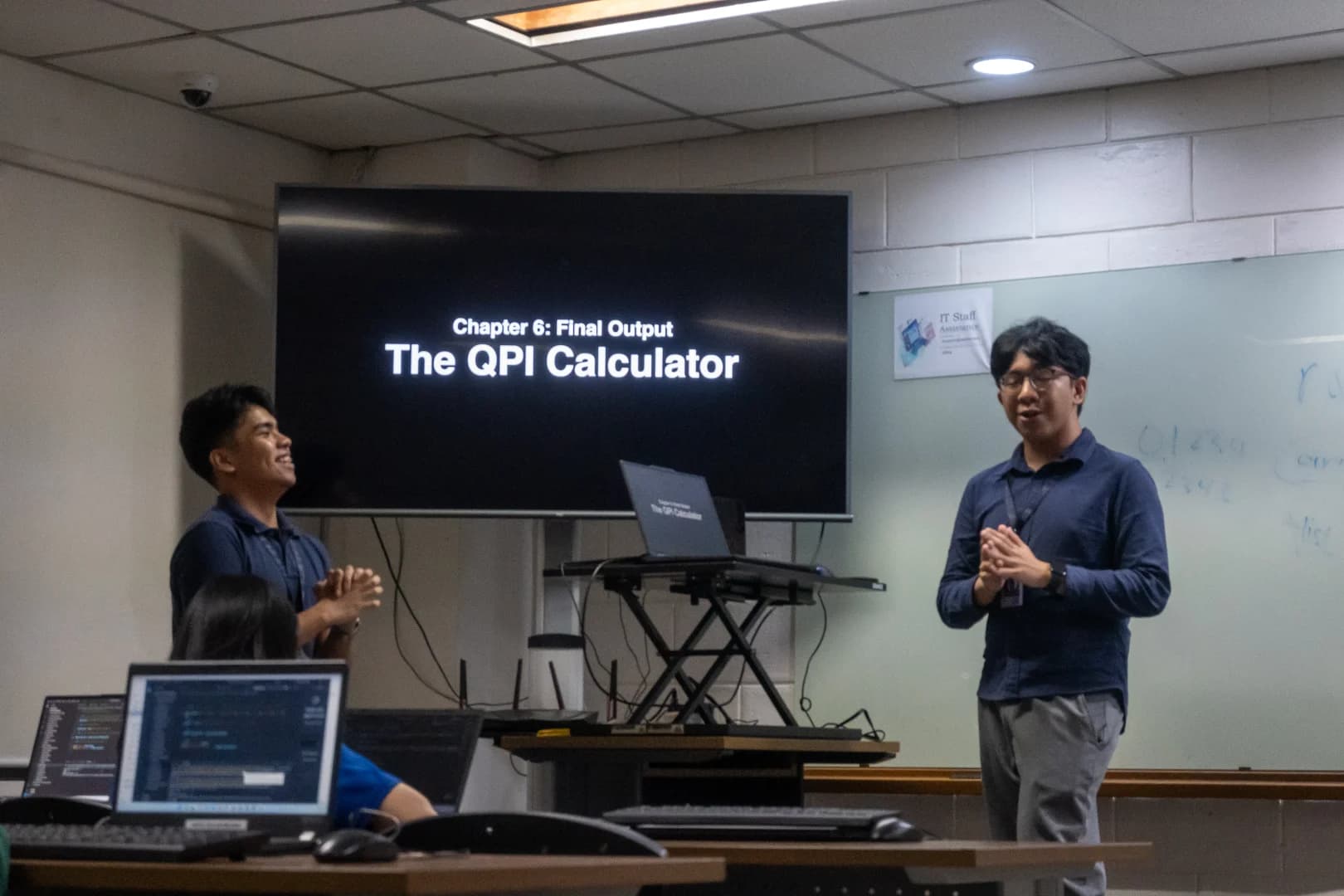
I co-hosted a Python workshop for Ateneo MISA with Alexi Canamo, built around one practical goal: help participants go from the basics of programming to a working QPI calculator in 90 minutes.
The session had to move fast. We covered variables, conditionals, loops, functions, and input/output, then tied everything together through a small calculator students could actually run and modify.
Why a QPI calculator
The project worked because it was familiar. Everyone already understood grades, units, and weighted averages, so the code had something concrete to attach to. Instead of teaching syntax in isolation, we used Python to model a problem students already knew.
That made the workshop less about memorizing commands and more about seeing how a program is assembled:
- ask for inputs
- store values
- repeat a process
- compute a result
- show the answer clearly
Teaching it
Compressing Python into one workshop forced us to choose only what mattered. The hard part was not the code. It was deciding which details to skip so people could keep momentum and still understand what they were building.
By the end, the satisfying part was watching people connect the pieces. A small calculator is not a huge product, but for someone writing their first scripts, seeing their own logic produce an answer is a pretty good first win.
What I took from it
Teaching made me better at explaining software. It forced me to slow down, name the mental steps I usually skip, and turn abstract programming concepts into something someone could build with immediately.
That is a practical constraint for engineering too: if I cannot explain the system clearly, I probably do not understand it cleanly enough yet.